

Transformational Leadership Training with BTFA: From Belief to Breakthrough
Forget what you think you know about leadership training. Traditional methods miss the core drivers of real change: Beliefs, Thoughts & Feelings. Our transformational leadership training, powered by the BTFA model, rewires these elements to shift culture and performance where it matters most. Ready to see how neuroscience reshapes leadership for lasting impact? Explore more here.
The BTFA Model: A New Mindset

The BTFA model challenges traditional leadership frameworks. It’s not just about skills; it’s about beliefs. By focusing on how leaders think and feel, we’re paving the way for real change. Curious about how this works? Let’s break it down step by step.
Rewiring Leadership Beliefs
Beliefs shape actions. If leaders hold limiting beliefs, they face barriers. So, how do we tackle this? We start by identifying these barriers. Once spotted, leaders can reframe.
-
Understand the Root: Many leaders don’t realise their beliefs hold them back. By examining their core beliefs, they can begin to change their reactions.
-
Change Through Awareness: Once aware of the neurological mechanisms behind beliefs, leaders can shift their perspective. This shift leads to improved decision-making and greater success.
This transformational leadership training is about more than just change. It’s about empowering leaders to see and do things differently.
Cognitive Reframing Techniques
Thoughts influence behaviour. By reframing negative thoughts, leaders can inspire positive actions. But what does this mean for you? It means better leadership through clearer thinking.
-
Challenge Your Thoughts: When faced with a challenge, think differently. Reframe the problem, and solutions become clearer.
-
Train your autopilot : When we reframe our thoughts, challenges become opportunities. This cognitive approach leads to innovation and growth.
By focusing on thought processes and cognitive requirements, leaders can transform their teams and themselves, avoiding the ‘integration risk’ most suffer in silence. Discover more here.
Emotional Regulation for Leaders
Emotions drive leadership. How leaders manage their emotions impacts their teams. But how can leaders improve this skill?
-
Recognise Emotional Triggers: Understand what stirs strong reactions. By recognising triggers, leaders can manage responses more effectively.
-
See People as their Brain: Understanding that the behaviours we see on the outside are ‘brain output’ helps us staying present, understanding and respectful. This practice enhances decision-making and reduces stress.
Regulating emotions is crucial for maintaining a positive team environment. It leads to more consistent performance. For a deeper dive into the science of quality and performance.
Practical Application in Industries
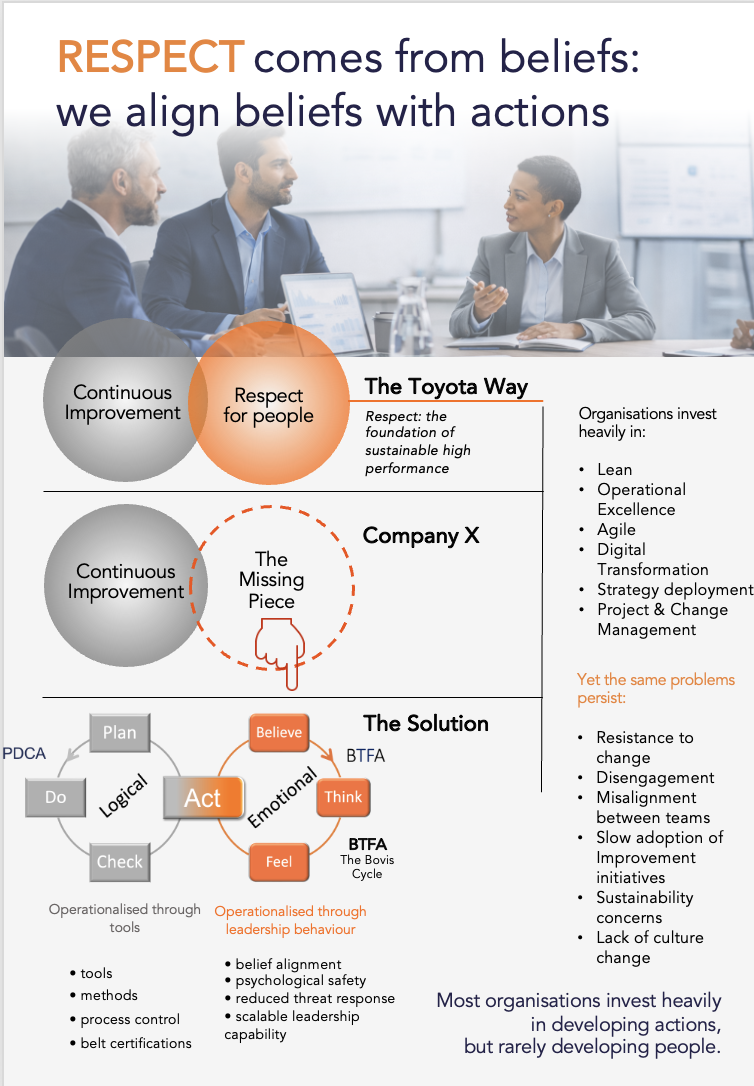
The BTFA model isn’t just theoretical. It’s been applied successfully across various sectors. Let’s explore how it works in real-world settings.
Manufacturing Success Stories
In automotive and aerospace, efficient and effective leadership is vital. The BTFA model has transformed operations in these fields. Want to know how?
-
Boosting Productivity: By reshaping beliefs, leaders saw increased productivity. Teams worked more cohesively to solve problems and achieve targets faster.
-
Reducing Errors: Cognitive reframing led to fewer mistakes. When leaders reduced the sources of stress, innovation, clarity and critical thinking improved. Fewer errors occurred.
-
Navigating Change: Leaders learned to handle industry shifts better. By changing their mindset, they navigated changes smoothly.
-
Improving Engagement: Emotional regulation kept teams motivated. Engaged employees led to better customer service, while root cause problem solving and well executed capex investments, improved margin on prior loss-making parts and higher profits followed.
These industries have seen significant benefits from BTFA. It’s more than just a model; it’s a solution to common industry challenges.
Customised Pathways for Executives
Executives need tailored solutions. The BTFA model offers customised pathways for leadership growth. What can you expect from this approach?
-
Personalised Coaching: Every leader is different. Custom training addresses unique challenges and strengths.
-
Strategic Development: Focused on long-term success, these pathways build robust leadership skills.
Executives benefit from a programme designed around their needs. It’s about achieving excellence and sustaining it. Find the right path for you.
Measuring Success and Engagement

How do you know if the BTFA model works? By measuring success through clear, tangible metrics.
Evidence from Red Flag Reports
Red Flag Reports highlight areas needing attention. They offer insights into potential risks and guide improvement strategies.
-
Identifying Issues: The report shows where problems may arise. By addressing these early, leaders prevent bigger challenges.
-
Guiding Solutions: Findings from the report help tailor solutions. It ensures leadership strategies remain effective and relevant.
With these reports, leaders gain a clear view of progress and areas for growth.
Behavioural Changes and Performance
Behaviour changes result in better performance. But how can you measure this? Through consistent observation and feedback.
-
Visible Shifts: Leaders see changes in team dynamics. More collaboration (less friction in relationships) leads to higher efficiency.
-
Continuous Feedback: Regular feedback helps refine strategies. It ensures leaders stay on the right path.
Improved behaviour directly impacts organisational success.
Engagement and Culture Shift
Engagement drives a positive culture shift. How does BTFA facilitate this transformation?
-
Empowered Teams: When teams feel valued, engagement rises. This leads to a stronger workplace culture.
-
Shared Vision: Aligning beliefs and actions creates a unified direction. Teams work together towards common goals.
-
12% in year engagement rise in Toyota Boshuku (Turkey) Great Place to Work Survey
The longer you wait, the more you miss out on these benefits. Start your journey today.
In summary, the BTFA model offers a comprehensive approach to leadership development. By focusing on beliefs, thoughts, and emotions, leaders can transform their organisations. Whether in manufacturing, finance, or any other sector, the potential for growth is limitless. Are you ready to embrace this change?