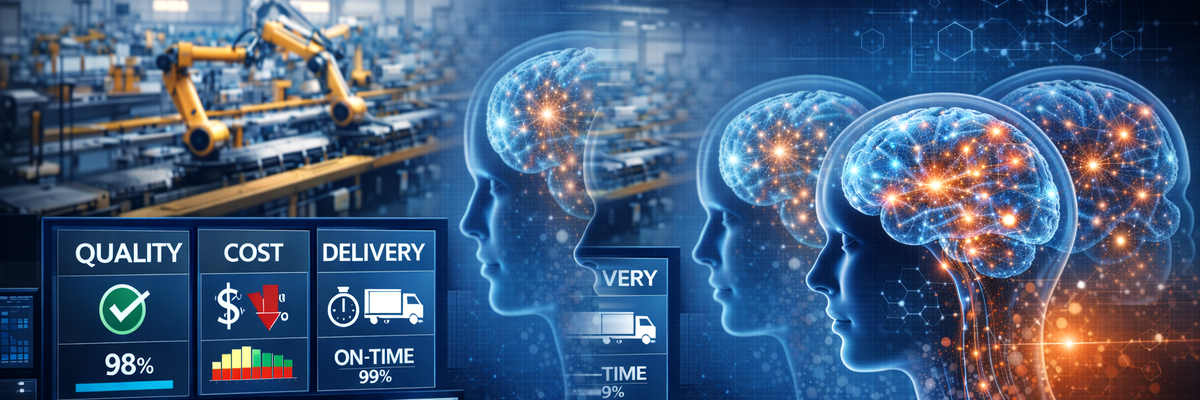
In operations, we are relentless about rigour.
- We measure Quality.
- We optimise Cost.
- We compress Delivery.
- We track tolerances.
- We analyse variation.
- We run experiments.
- We monitor throughput.
We would never accept “improve quality” as a slogan without defining standards, inputs, constraints, and measurable outcomes.
And yet when it comes to culture and people, we abandon that discipline.
We say:
- “Put people first.”
- “Improve mindset.”
- “Increase engagement.”
- “Build morale.”
But we rarely apply the same thinking about the biological system as we do about machinery and process.
The Missing Layer: QCD Applied to Brains
If the brain is the mechanism behind behaviour, decision-making, and collaboration (i.e. how people relate to self-others and things – the building blocks of culture), then culture is not abstract.
It is the quality of inbound sensory stimulus people receive every day and the chemical state produced in each brain as a result.
Every instruction, tone of voice, metric (KPI [imposed]), email, escalation, target, and meeting qualifies as ‘stimulus’.
And stimulus shapes neural wiring, firing patterns and chemical mix.
If we truly applied QCD thinking to the “people side,” we would ask Questions that focus on the biology in play:
Q – Quality of Stimulus
- Is the input people receive clear, respectful, predictable, and aligned?
- Or is it ambiguous, judgmental, threatening, and inconsistent?
Poor-quality stimulus produces defensive wiring.
C – Cost (Metabolic Load)
- What is the emotional cost of operating in this environment?
- Is cortisol chronically elevated?
- Are people cognitively overloaded?
Stress consumes glucose and limits prefrontal function.
That has consequences for judgement, creativity, and collaboration.
D – Delivery (Over Time)
- Is the stimulus presented (e.g. to train new methods) consistent over the time frames required for neural adaptation, and designed to facilitate neurological change?
- Or is ‘training’ designed to deliver facts about technical subjects?
- Is the stimulus presented to improve operational performance consistent over time frames required for neural adaptation?
- Or are initiatives changed every quarter, and new projects launched on top of prior projects that haven’t been bottommed out, resetting trust each time?
Brains adapt best through emotionally charged experience, and then repetition and positive reinforcement – not PowerPoint and changing priorities.
The Forgotten Letters: GSM
When Toyota thinking was first interpreted in the West (When I was first introduced to it), QCD always appeared alongside GSM:
- Growth
- Safety
- Morale
Somewhere along the way, many Western interpretations reduced the model to QCD.
- Financial and operational metrics remained.
- Growth became revenue.
- Safety became compliance.
- Morale became a survey.
But at its original intent – especially through concepts like Hitozukuri;
Growth was human development more than it was revenue or profit performance .
Safety was psychological as well as physical.
Morale was what we now know to be a chemical state – trust, energy, and belief.
We operationalised QCD.
We abstracted GSM.
And culture became a poster.
Culture Is Not a Value. It Is a Neurobiological Outcome.
People do not behave well because of slogans.
They behave according to how their brains interpret risk, status, identity, and safety within the system.
If the socio-technical environment produces:
- Predictability → Safety increases.
- Autonomy → Dopamine balances.
- Fairness → Oxytocin rises.
- Competence → Serotonin stabilises.
If it produces chronic threat:
- Cortisol rises.
- Defensive behaviour increases.
- Narrow thinking replaces collaboration.
That is not opinion. That is biology.
The Real Parallel
We would never try to improve machine performance without understanding how the machine works.
Yet we try to improve organisational performance without understanding how brains work.
We throw data at leaders under pressure and expect belief to shift.
But belief updates through experience – not information alone.
If we applied QCD rigour to the “people” dimension, we would design environments with the same discipline we apply to production lines.
We would treat neural adaptation as seriously as takt time.
We would recognise that:
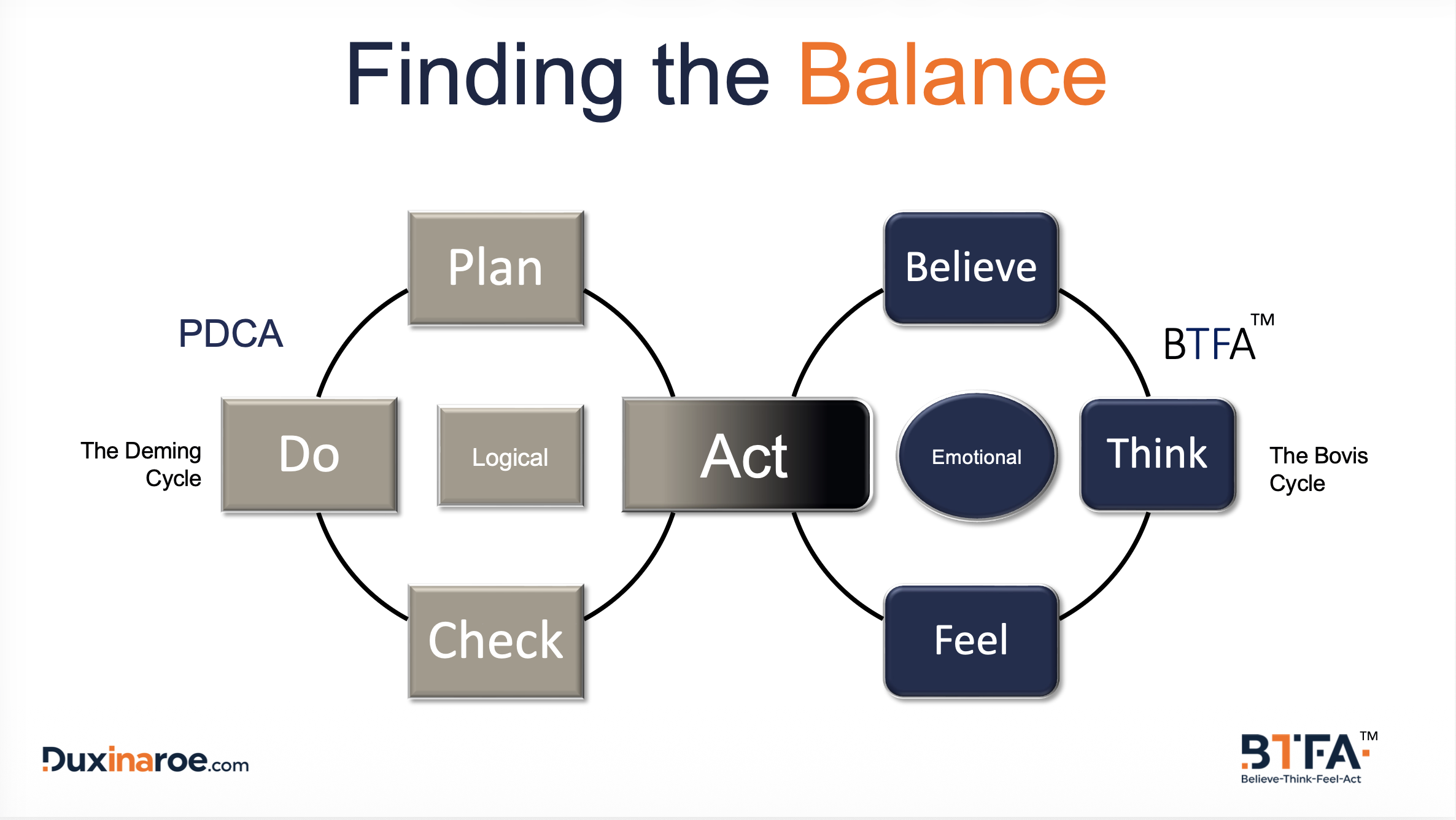
Growth, Safety, and Morale are upstream of Quality, Cost, and Delivery.
Until then, we will continue to optimise processes while wondering why behaviour doesn’t shift.
The system is working perfectly.
It’s just working on one type of mechanism (logical / technical) while systematically ignoring the other (emotional).